
The Invisible Fist (Part II)
June 27th, 2012 | 9 commentsIn response to my letter to the CBC’s new show on (neoliberal) economics, here is a thoughtful letter from host Mathew Lazin-Ryder. I certainly appreciate his response, though I’d like to emphasize, he appears to believe that “governments don’t exist.” Ponder carefully what he has to say. My response, which seeks to clarify his neoliberal position — that “markets” exist before governance — is below. We’ll see if he has the time to reply further. / tV
From: Invisible Hand <invisiblehand AT CBC.CA>
Date: Wed, 27 Jun 2012 15:20:03 -0400
To: “tobias c. van Veen”
Subject: Re: Economic Examples without Consequence
Hello Tobias,
Thank you for your email. Yes, things are always more complicated than time allows. As for economists not being one solid lump, that is quite true. Our research did find a broad consensus amongst mainstream economists about the economic principles behind anti-price gouging laws. There certainly are things over which economists disagree, but I’d put anti-price gouging laws below many others on the list.
I also understand that our simulation was an over-simplified version of reality, which is exactly as we intended it to be. Sure, there are what-if, and comparisons of laws and economic structures, which is why we reduced the variables. 1 city, 1 law. Price-gouging, non-price gouging. We also, of course, removed the variable of personal wealth. While this is indeed a simplification of reality, we found the judgement that if a person had 1 dollar, they might also have 10 dollars, an acceptable one.
Indeed, I heartily agree that there are better scenarios – an efficiently run government that operates purely in the interest of the populace. Unfortunately for the world, I’m not sure that government exists – it certainly did not in our simulation. There are deeper implications, there are further considerations, there are caveats and what-ifs. The idea behind our show is that before we can even begin to talk about those as a society, we need to know how the basics are supposed to work – or at least, what a significant, if not major portion of an academic field believes to exist.
All the best,
Matthew Lazin-Ryder
CBC Radio Vancouver
================
From: “tobias c. van Veen”
Date: Wed, 27 Jun 2012 12:52:28 -0700
To: Invisible Hand <invisiblehand@CBC.CA>
Conversation: Economic Examples without Consequence
Subject: Re: Economic Examples without Consequence
dear Mathew,
Thanks for your response, indeed.
> Indeed, I heartily agree that there are better scenarios – an efficiently run
> government that operates purely in the interest of the populace. Unfortunately
> for the world, I’m not sure that government exists – it certainly did not in
> our simulation.
This is troubling. Your entire model of economics is dependant upon *not having a government* ?
Who provides the currency in your model, then?
> There are deeper implications, there are further considerations, there are
> caveats and what-ifs. The idea behind our show is that before we can even
> begin to talk about those as a society, we need to know how the basics are
> supposed to work – or at least, what a significant, if not major portion of an
> academic field believes to exist.
I’m in that field, and many of us would say that what exists first are social relations of power, and thus the primacy of politics, over economics. That is why policy is set by governments.
Of course, I effectively understand what you are saying is the opposite: that the “basics,” for you, means economy before government, capitalism before democracy. That governance is secondary to finance, in short.
In short, you are a neoliberal capitalist and an anti-democrat, correct?
Ie, you believe that “society” exists in the “market” before there is political organisation or representation of the “society” in a State?
I’m just curious, as this is, of course, a basic tenet of neoliberalism, which privileges the “market” before governance. (As the radicals would put it money before human rights, profit before people.)
I’d say many people would find the idea that we should imagine economic scenarios without governance deeply problematic. As deeply problematic as imagining that people all have the same amount of money. It all sounds like a fantasy to me. The question is, who does this fantasy benefit?
I think it’s fairly easy to see whom: those with the most amount of money.
At least, unlike Thatcher, you find that there is such a thing as “society.” However, in your example, there was none. Only individuals — with money. So I take this as a bit of an error on your part.
If governments “don’t exist,” why should “society”?
I look forwards to further shows either questioning these troubling, anti-democratic assumptions, or, more likely, continuing to espouse neoliberalism as “basic tenet” — a core ideological operation if there was one.
You don’t mind if I quote you in an article saying that “governments don’t exist,” do you?
best,
tobias.
The Invisible Fist
June 27th, 2012 | 5 commentsLetter to the CBC’s new show on (neoliberal) economics, The Invisible Hand. The letter is self-explanatory. The first episode provided such a weak justification of the so-called “free market” that any first-year philosophy student could’ve poked holes through it.
dear Mathew & Invisible Hand,
Thanks for your new show. As a student of political economy, I found it interesting, and I always like it when radio tries to break down topics like economics for the listener.
However your example provided today was quite lacking in the reality department. I want to pick through it a bit, because I think you can go a lot deeper than this. The consequence of not revealing the true difficulty of economic policy decision-making is obvious: you refer to “economists” as if they are one bunch of people, all thinking the same thing. This, of course, is not the case. The “economists” you are referring to in your show on Hurricane Katrina are neoliberal economists, who believe in a fictional caricature known as the “Rational Actor,” who also plays in a nearly fictional environment known as “the free market.”
Indeed, current “economists” have finally begun questioning these models after fourty years of near unquestioned dominance within mainstream “economics” circles. But I digress.
Let’s liven up your example, and remember that all economics includes ethics. In short, economy, because it always involves people, and thus tensions between individuals and the collective authority that we call the State, is always political economy.
=== THE ICE IS FOR SALE : A REAL SCENARIO ===
In your example, ice is for sale during a disaster. Your customers include those seeking non-essential uses (corsages, cookies) and those seeking essential services (health care and emergency response).
But no mention is made of the purchasing power of the health care and emergency services. Let’s pretend we’re in Canada first.
SCENARIO 1: FREE MARKET ALLOWED, CANADIAN CONTEXT
1. The hospital can only afford $10 worth of ice. At the normal rate of $1 per bag, it can keep alive its ten patients. At $9 per bag, it can only keep alive one patient. This is the first consequence of the so-called free market, where prices are allowed to rise during a disaster.
1a. Of course, the hospital has emergency funds, and so they dip into them or borrow funds of the public trust to buy ice at 9x the price, thus paying $90 for the ice that would’ve cost $9 before the disaster. This has immediate consequences — the hospital has now spent the money it had saved up for a new diagnostic machine, and so cancer patients awaiting this new treatment will suffer, and perhaps die because of it. Further, the hospital now has debt to pay off if they borrowed the money, plus interest. Where will the hospital get the funds? In the Canadian system, from taxes and/or increased user fees. The ultimate consequence of hospitals paying 9x the price is that taxes rise to cover the trickle down effect of inflated purchases — all so that the corner-store ice owner could make 9x the profit, or, as neoliberal economists put it, “equitably distribute the ice to the agent with the highest need.”
Meaning, in short, we all pay the cost for a single individual’s wealth, while risking lives in the process.
SCENARIO 2: FREE MARKET ALLOWED, U.S. CONTEXT
1. The public hospital can only afford $10 of ice. It is in the same situation above, except that it cannot raise taxes due to neoliberal economic policies that keep taxes down, so that the “free market” can operate more freely. After the disaster, the hospital is shut down as it costs too much money, and the 9x-the-cost acquisition fee is paraded as proof of the inefficiency of the public service. Scores of uninsured Americans fall through the cracks — the deaths are of course unreported, as there is no public service to do the analysis.
1a. Of course, there is a private hospital buying ice too that can well afford the ice. It buys a large chunk of the available ice with the wealth it has from privatized, high-end health services delivery. Those with health insurance (mainly the wealthy) receive the ice and live through the disaster.
The meaning here is obvious: services with equity survive, and so do their wealthy patients; those without wealth do not. Might makes right in this “free market.”
SCENARIO 3: NEITHER / NOR: THE STATE IS FOR ALL
In your example, you only offered two choices: either all bags of ice are sold for $1 at a first-come, first-serve basis, or the seller can raise the price to exclude so-called frivolous buyers, so that only those with the greatest need buy the ice.
Of course, this is already a fallacy. Investors can buy and hoard ice, creating a futures ice market during the disaster, and trade large amounts of ice to scaled buyers (those with wealth), creating price fluctuations that generate large amounts of profit. This already exists on a formal scale, and is called the stock market. During disasters, this exists in the form of what is usually called the black market. Throughout history, such markets have popped up — such as in Leningrad during the siege of World War II. However, the people turned on such “free marketeers,” distributing street justice to hoarders and profiteers. And for good reason; the above example should demonstrate that no market is “free” when there is inequality of means to begin with. So here’s a truly rational, third example:
1. The hospitals and all emergency services are given priority access to the ice market by the State. All corner-store shops are mandated to sell ice to health personnel at the normal rate of $1. In this scenario, hospitals and emergency professionals get what they need, thanks to the emergency provisios of the State, which steps in not to “interfere with the free economy” but to insure that the economy does not enter a period of hyperinflation that would only benefit the wealthy (those that could afford the ice or private services that can) and which would have disastrous consequences upon the impoverished and upon public health as a whole (the impoverishment of health services would result due to hyperinflation of necessary supplies).
Indeed, this is what we already have in Canada and the US: various services are declared essential services. (However, in the current situation, this is usually only enacted to limit the right of labour to strike, rather than to provide fair access to necessities — but I digress.)
1a. In times of dire emergency — what is called a “state of exception” — the State can go much further than this. In World War II, many States introduced food stamps and rations. In this scenario, all ice production is monitored and controlled by the State, to ensure that everyone receives a fair portion (this is also how Leningrad survived the Siege of World War II: without such strict rationing, ie, not only intervention of the State into the market, but direct control of supply and demand by the State, many more would have died). Indeed, in extreme examples, the State has the right to commandeer property and materiel (though today this is abused to kick out land owners for the benefit of mining, the oil and gas industry, shale fracking or pipelines — such as in Québec’s Plan Nord; but I digress again).
1b. If things aren’t quite that bad, but bad enough, the State can introduce intermediary policies, such as demanding that ice be sold direct from producers and distributors to health services at cost — at enough of a margin to cover expenses and live from, but less than standard pricing, say at 40% off retail. In this scenario, less profit is made by one industry in order to better provide the required health services for all. In short, the short-term profits of the few are sacrificed to save the lives of the many. The State has every right to do this to protect its health care services in times of disaster.
Moreover, it is right to do so: by ensuring cheap supply to necessary services, there is no tab to pick up later. Companies selling the required services make a tad less profit, and certainly don’t reap in profits from price-gouging, but neither do they go under or face higher taxes as a result of the “free market,” had it been allowed “free reign” to raise prices to obscene levels.
=====
I sincerely hope that in future shows you go beyond the facile, bloodless examples you’ve already provided. There are no economic policies without consequence, especially when dealing with disasters. Economics always involves ethics.
The correct answer to the real-life problem of disaster supply management is that both of the options provided on the show — either $1 pricing or $9 price-gouging — are ultimately inefficient and wrong. In both cases the “market” is relied upon to provide necessities without any hint that a democratic state has the authority to garner what resources it needs to ensure the survival of the many, if not all.
This is what democracy means: it is above the market.
The actual reality is that the State ought to, and as in the case of Katrina, finally did step in and provide such necessities.
As for the Louisiana ice-seller, some laws are necessary here, because the actual issue is not price-gouging, but street justice. If a seller is seen as contravening the basic ethical principles of community that arise from human nature during such disasters, such a seller may be dispensed without mercy. Indeed, the law is there to limit such activities to protect the safety of such sellers. A better solution would be to have the State request all entrepreneurs to maintain prices at a fair percentage; and they too would be subject to certain pricing regulations when selling to health and other necessary services.
So in this case, Louisiana should not have made an example out of the truck seller (who sold generators). A true example should’ve been made of the hired mercenaries — ie Blackwater USA — that poured into New Orleans to secure the privilege and property of the wealthy, distributing privatized violence at will, and introducing a climate of fear that descended into racism on a mass scale.
Hopefully your show will go much farther in demonstrating the ethical choices behind economic policy in future episodes, as well as showing that alternatives to either/or propositions exist. At the least, I hope your show will stop referring to “economists” as some homogenous group. As a political economist, I certainly found little to agree with in the models presented, for they are nothing but fictions designed to present what many of us “economists” would argue is a dangerous neoliberal ideology: that of the “free market.”
Dancecult 4(1): The Exodus of Psytrance?
June 24th, 2012 | No comments yet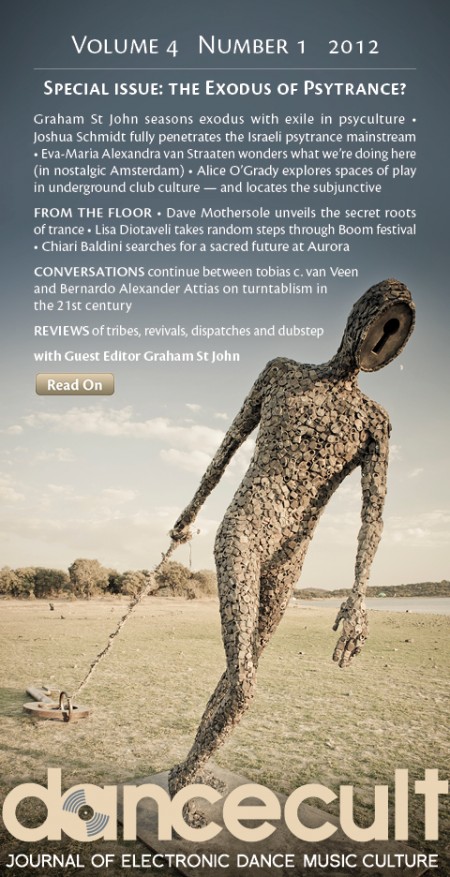
Indeed, it is out, issue 4(1) of Dancecult: Journal of Electronic Dance Music Culture. This issue special edited by Graham St John on the question: The Exodus of Psytrance?
Btw, here’s how to get on Dancecult’s mailing list.
This issue includes a few contributions on my part (besides the PDF layout and overall HTML finalization), namely a few reviews and part two of my conversation with Bernardo Alexander Attias on turntablism and controllerism. It is well worth reading part one if you’re intrigued, otherwise what we have to say doesn’t make much sense off the bat, truncated as it is from what was published previously.
++++++
DANCECULT | Journal of Electronic Dance Music Culture
==================
Volume 4 * Number 1 * 2012
==================
http://dj.dancecult.net/
SPECIAL ISSUE ON “THE EXODUS OF PSYTRANCE?”
with Guest Editor Graham St John
CONTENTS – DANCECULT 4(1)
## Feature Articles ##
Seasoned Exodus: The Exile Mosaic of Psyculture
— Graham St John
Full Penetration: The Integration of Psychedelic Electronic Dance Music and Culture into the Israeli Mainstream
— Joshua I. Schmidt
“What are we doing here?” Nostalgic Desires for a Cosmopolitan Sensory Aesthetic in the Amsterdam-based Psytrance Scene
— Eva-Maria Alexandra van Straaten
Spaces of Play: The Spatial Dimensions of Underground Club Culture and Locating the Subjunctive
— Alice O’Grady
## Conversations ##
Off the Record: Turntablism and Controllerism in the 21st Century, Part 2
— tobias c. van Veen and Bernardo Alexander Attias
## From the Floor ##
Unveiling the Secret: The Roots of Trance
— Dave Mothersole
Random Steps Through Boom Festival 2010
— Lisa Diotalevi
Aurora Festival and the Sacred Rituals of Samothraki: Past, Present… What Future?
— Chiara Baldini
##Reviews##
Tribal Revival: West Coast Festival Culture (Kyer Wiltshire and Erik Davis)
— tobias c. van Veen
The Tribes of Burning Man: How an Experimental City in the Desert is Shaping the New American Counterculture (Steven T. Jones)
— Susan Luckman
Discombobulated: Dispatches from the Wrong Side (Simon A. Morrison)
— Bina Bhardwa
Bassweight
— Phil Kirby
===
With Deep Bass Rumblings
Graham St John
Executive Editor
tobias c. van Veen
Managing Editor
============
DANCECULT 4(1) 2012
============
never resign the public sphere
April 12th, 2012 | 1 commentOften I find myself engaging on Facebook, as do we all — the problem is that such conversations disappear. Time to start archiving them more properly, and to resurrect the role of this blog. The conversation below jumpstarted from an offhand suggestion to writer Leslie Anthony that we start pooling our energies to work that critiques the Harper regime in Canada. This brought about some surprise criticism.
Before I begin, I believe that one of the most urgent tasks of leftists who can craft a word or two is overcoming defeatism from within — as well as turning to the task of producing penetrating and readable critique of the right, at all levels from popular journalism to philosophical jousting. The ideological problem is that many leftists have been convinced that the realm of media critique and the public sphere has been all but deflated by the right. Oddly, this forces the call for action, but rather than mobilizing action and taking ahold of the opportunity, this forces many into resignation — and into the defeatism of resigning control of the public sphere and media to the right. This is strategically handing the board over to your opponent, pieces and all.
Click on the screenshots to make them bigger.
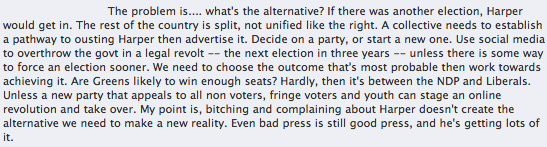
The problem is not “what is the alternative” — as if those opposed are grasping around at straws. Perhaps we can begin with restoring the rule of law, organising governance for the many and not the few, and taking as principles the equitable redistribution of wealth within an ethics that takes as paramount ecological sustainability and human rights? Even these old, classic, liberal values appear as revolutionary today.
Our not-to-be-named respondent (I respect the privacy of Facebook here, however slight) makes some very good points that are indicative of widespread malaise and disenchantment. This of course needs to be ousted openly, like airing our dirty laundry, exposing this little secret of resignation so we can get over it and move forward with the energy of an attack.
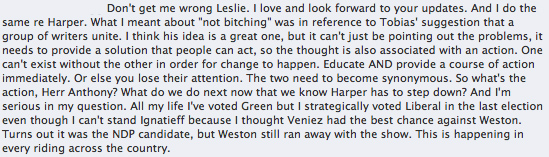
To wit, and to reply, then: a letter to one so resigned.
dear [name removed], I agree that action is necessary, but what you’re asking for is a solution on a plate: you don’t want action unless someone hands you a “solution,” readymade and consumable, and until then, you take the defeatist attitude of “there is no alternative” or “what’s the point.” Your “solution” is silence and complicity. This is not only defeatist, its strategically plays into the hands of the neoCons — just like your vote for a Liberal, even though you didn’t support their elected leader or party. In short, your strategy failed, so continuing to pursue it seems to be a mistake, no?
As for the possible action of writers — the very reason the neoCons are attacking CBC as well as StatsCan and information services (health, science research) is because they are creating the conditions for a deficit of informed decision-maing in the public sphere, thus paving the way for ever more irrational policies (or lack of policy entirely). Amassing critical writers by wresting back control of the public sphere, and by defining and remaking that public sphere itself as exterior to the mentality of consumer capital, is a powerful weapon and should never be discounted; in fact it has been the leverage for most change in political currency for millenia, besides, of course, brute force.
So I don’t agree with you that investigative reporting and critical media is worthless unless we “provide a course of action immediately.” That is asking us as writers to be your Great Leader(s) and to hand you all the answers when such action is the responsibility of ALL, not just some cabal — it’s the same ideological ploy that the neoCons exploit (“why do anything? why bother? why isn’t anyone telling me what to do?” etc).
I also don’t buy the argument that otherwise “you lose their [and who is this “their”?]” attention.” Believing in mass ADD perpetuates it. Taking the other tack ignites attention. In any case, to reflect once gain upon your voting strategy, it has clearly demonstrated that the alternative is the NDP, front and centre. The numbers do not agree with you: the rest of the country is not split. It is quite unified around the left, and predominantly around the NDP. Your own observations above demonstrate that. This is a long process; it took 10+ years to unite the right; don’t think it will be a magic bullet for the left. Nor is the right completely unified; the budget has disenchanted right-wing voters too, and this disenchantment needs to be exploited — by targeting queasy right voters who voted conservative for economic reasons that are now being shown up as awash not in capitalism but religious ideology and irrational cuts. And this is the work of critical media; to sway opinion with research and fact, to expose the underlying and ugly truths. And this is speaking truth to power and the moment one gives up this belief, one is dead — a corpse of resignation.
Vote where your heart is, write where your heart is, and get strategically savvy. Otherwise you’re in the resignation camp — enjoy the bedfellows; they are but the true bitchers. The rest of us are moving forward. Can we count on you?
FOLLOW UP.
Here’s some words that followed in regards to (dialectical) strategy.
^^ Do you know what I read daily? The Economist, which is hardly left. But even The Economist openly ridicules both the GOP/Tea Party and — guess what — Harper’s Canada, which they see as more of the same, though in softer, court-jester form. In short, the lack of a Canadian environmental policy means that for oil-exploiting capitalists there is uncertainty in the markets as they cannot think ahead nor invest with confidence. Canada’s position in regards to the environment and fossil fuels is unclear and ambiguous. So on this front alone, there is dissension in the right. This gap needs to be widened so that the true issue of self-destructive environmental exploitation can be exposed and brought to light: not only that Canada needs an environmental policy, but this policy needs to be one that addresses capitalism as the root of ecological exploitation to begin with. This is a big step but one always possible through a leap over the abyss, and this is the moment of action, of explaining precisely this shift to the many: this lack of a policy, in this case, opens the door for us, as leftists, to create a policy much more radical and far-reaching. Present this policy openly, and suddenly, it fills a hole, creates a gap where the Conservatives have no reply and no ideas. This is precisely what the Liberal/NDP opposition are doing right now in regards to the F-35s; they are turning the logic of capitalist competition back upon the Conservatives themselves by asking why the jets were not sent out for tender…
dispatched
April 11th, 2012 | 3 comments
Yesterday — a day of mourning. Close family, a beautiful & pioneering female skier, and CBC. But right now it’s the Harper agenda against our public broadcaster that has me infuriated. Radio One’s Dispatches has been axed completely — one of the only venues for independent, international, investigative news reporting. Gone. Should we speculate why? Perhaps one Canadian mining or oil and gas expose too many? The erosion of democracy is so easy to accomplish against the backdrop of complacency. Ownership of the media — à la Berlusconi — is the first step to consolidating absolutist power. Dispatches is but one casualty in a coordinated, slow erosion of public institutions and media in Canada. Fight back, Dispatches crew. DO NOT GO QUIETLY.
Berlusconi’s reign over Italy is an interesting example. Did he go because of public uprising, because of political overthrow? No, it was only when Berlusconi’s use of the State as his personal fiefdom endangered the power of capital that the multinational bankers stepped in and installed a technocratic council to rule the State. The catalyst to this was not social unrest, mass protest, or democratic upheaval, but the 2008 financial crisis. Like Greece, Italy is now run by unelected technocrats. Berlusconi has managed to evade every single charge brought against him; he publicly flaunts his largesse and lack of ethics.
Harper is the shadow to Berlusconi’s fireworks. All the same strategies are in play — slow erosion of democratic institutions; the flaunting of power and wealth; the complete monopolization of state media. Unlike fascists of the 1930s, today’s neoconservatives know to move slowly by strategically defunding independent public services from the environment and sciences to public broadcasting and food safety. The result is an unstable state lacking the communications and critical media to report upon its wholesale privatization.
A week ago I heard an anti-CBC caller played back on As It Happens: “You should compete like everyone else,” she said, “If I had my way the CBC would receive no funding at all.” Here we have a perfect example of neoconservative, capitalist ideology: here, it is the market, and not public space, which is the norm. Compete like everyone else, join the market; the idea that the market is a private space, and that the space of collective realisation — the “everyone else” — is that of public space, publicly funded from the common wealth, has been completely reversed: now it is the market of competing monopolies that is the “everyone else,” the “we” in which we all feel included. Of course this makes sense given that the self-identity of the caller assumes that of the consumer; the CBC is an imposed purchase under this logic, and s/he doesn’t like what s/he’s hearing. The logic is simple: news is a product, as is all media, and I only want to buy what I like, what I want to hear or see. Of course, such consumerist self-identification undermines the basic principle of journalism, which is to expose all to the ugly truths we don’t like to hear or see.
The more the world approaches ecological catastrophe, increasing impoverishment, permanent militarization, rogue state conflict, the inequality of wealth and power, etc., the more this “everyone else” rebels, creating bunkers of ideology, erecting barriers and fences to the in-common, collective experience of facing ugly truths. The right-wing, Tea Party insanity of the GOP and militant Islam are reactions to the destabilizing and ultimately self-destructive effects of global capitalism. That both aim to fight each other in a duel to the death ignores the true apocalypse brought on by global capital itself—a simultaneous erosion of democracy and the pending ecological catastrophe.
The lesson is bitter and clear: the state political elites serve capital, they are unable and/or unwilling to control and regulate capital even when the very survival of the human race is ultimately at stake. (Slavoj Zizek, Living in the End Times 334)
This is the final logic, the end times. Zizek’s book is highly recommended.
espaceSONO resound
January 29th, 2012 | No comments yetWatching yourself later and over years past is not only like viewing yourself as another person, it is encountering yourself as a doppelganger, a completely distant other. An act, nearly complete. I wasn’t into this interview. It was formal and weird; and so was I. Which made it all the more weird. The point being, how can you film an aural exhibit? And so being-weird in the exhibit was the only answer.
Thanks to Renaud Kasma for capturing, editing & uploading this 2007 interview, shot in SAT’s now obliterated SAT_GALERIE, for the espaceSONO exhibit.
memory rewound: the space echo
November 14th, 2011 | 4 comments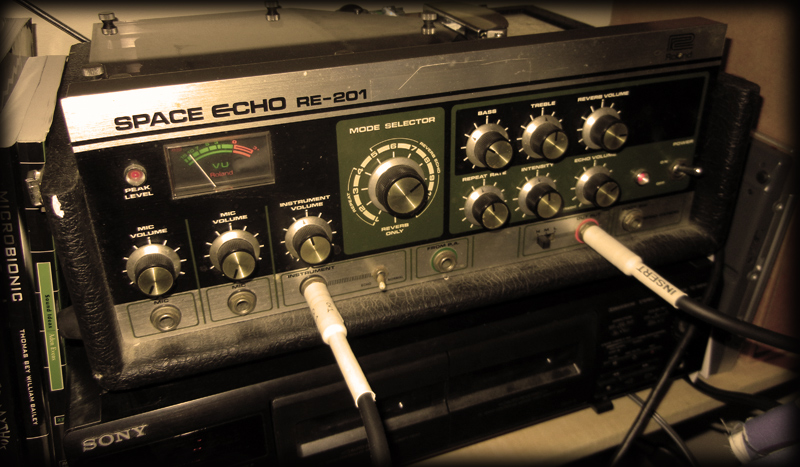
mnemotechnics interphase
This is a machine of mnemotechnics. Memory erased unto itself. The mystic writing pad looped in magnetic filament. A machine that spins tape back unto itself in a loop, eating itself, devouring itself, an interface of mechanical time, capable of repeating, reiterating, a sound, over & over, and sending it into space & echo. The Roland RE-201 Space Echo is such a machine. I have desired one for years. It is the basis of King Tubby and Lee Scratch Perry. It is a channel into the technics of space and time… it is a time travel device, a memory palimpsest on rewind. It is beauty.
Too bad I don’t have a PhD expense account. I couldn’t finish writing about the tape loop echo until I simply had one. Indeed, the most valid research expense yet, save for the thousands spent in books thanks to lack of VPN library access from McGill.
the pale fox
October 14th, 2011 | 1 comment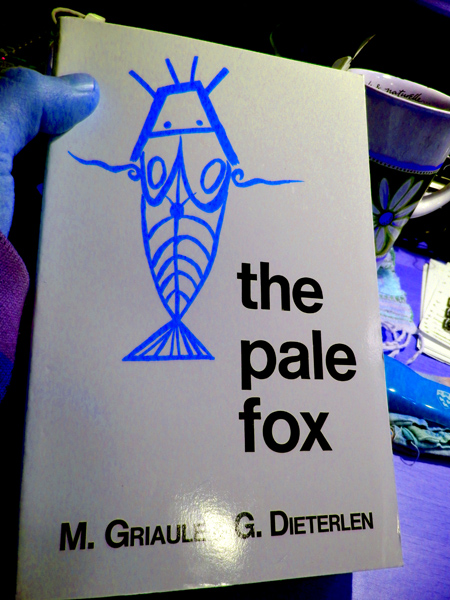
Pale Fox --- in hand
Finally—the anthropological source of the popular literature on the Dogon in hand. Why do the Dogon have a calendric system based upon Sirius? What is the meaning of their mythic systems, insofar as they resemble contemporary representations of scientific phenomena from DNA to mitosis? Is it possible they knew of the hidden planets and stars of Sirius, invisible to the naked eye until the invention of 20th century telescopes? How? And why? And from my perspective, from that of a mythos that might extend far beyond its current descriptors, aesthetics, socio-political coordinates: how far back does Afrofuturism extend, insofar as it claims to embody First Contact?
All questions destined to undermine the credibility of an academic career. Excellent.
blind signifiers in the new age
September 7th, 2011 | 3 comments
No More Potlucks 17
The seventeeth issue of the illustrious No More Potlucks, edited by Sophie Le Phat Ho, is dedicated to inducting its readers into magic — magie no. 17 | no more potlucks.
The choice of ‘magic’ as a topic came out of a concern – une préoccupation qui semble être partagée, vu la richesse des contributions présentées dans ce numéro – for what we are up against… En effet, la magie relève de la technique, de la pratique, du procédé, de l’art, de l’action. Elle est donc intimement liée à une analyse de la réalité, de l’environnement, et ne serait être de l’ordre du divertissement, de la fantasmagorie… Bref, this is serious. [Sophie Le Phat Ho, editor]
This issue features a brief piece I writ entitled Blind Signifiers in the New Age, introduced by a recent communication sent to Hakim Bey.
Blind Signifers is a condensed text on magick as the art of the slippage between signifers, the minimum distance of which constitutes consensual reality. Magick in this respect is a force in the sense that it generates effects wrought from symbolic subterfuge. Magick traverses the realms of the illusionary and the imaginary; it is precisely that viscosity that allows us to conceive of that which would puncture reality with its surreality or irreality. In this sense, magick (a) is generative through effects of signifying systems and (b) is not to be trifled with. Its underlying principle is that CHAOS NEVER DIED.

on the plains / Hakim Bey postcard
The principle point is that magick is very much in use all around us: it connects the surface of things; it is especially engaged to ensure consistency of action/reaction in systems of capitalist desire, notably consumerism. It is not magic at work here, not the mere trickery of an illusion, but magick, the technics of signifier slippage, the art of symbolic subterfuge. These be the darker arts when used to deceive.
Any such concept of magick as a praxis of symbols follows from the work of Hakim Bey, whose creative work with chaos theory (and the Mandelbrot Set), connecting anarcho-politics to the folds of physics and geography as well as the deconstruction of semiotics and philosophy some 25 odd years ago is, I would argue, indispensible to grasping semiocapitalism. Yet like all texts, including this one, it is writ with a cleaved-edge. Beware the folds.
There are many good essays in this collection (do read them) but relevant to my own work is Magic, Strategy and Capitalism: An interview with aladin by Anja Kanngieser and Leila, who pose the question “what happens to magic once it is embedded in the languages of business and industry?”. Indeed; this is the fundamental question that founds the dark art of advertising and second order cybernetics. However this question ought to be reinscribed: how is it that magick is the basis of capital? How is it that magick constitutes the language of capital itself?
To this end, I would suggest a deeper reading into the “tradition” of magick, as well as that of Marx. Perhaps magic has always been about entertainment and tricks, but magick operates at ways far more embedded into the technics of perception, which is to say, the way in which value is inscribed and perceived.
In this sense—which needs qualifying—the language of magic has been, as the article suggests, “put into use for capital,” but only as a secondary effect or diversion from the magick of capital itself. Reading Marx, magick is that operation which derives exchange value from use value. Capital operates by way of magick. It is that which makes the “commodity stand on its head” in Das Kapital. Marx often discusses capital as “phenomena” and “illusion,” as a “phantom,” but none of these are terms meant in the tradition of cheap tricks: a social relation is masked behind the relations of capital. Violent, dark magick, in other words, the magick of turning quality into quantity, humanity into slavery, world into resource, is at the heart of capital. Capital is no cheap trick; its cost is Faustian.
As Marx writes, capital’s effects are phantomic; it is precisely this haunting effect, this “specter” of capital which, according to Marx, needs to be exorcised. Over a century later, in 1994, Derrida argued in Specters of Marx that the phantom in general—hauntology—cannot be exorcised. In short, the revolutionary magick proposed by Marx (which was famously unthought) against the magick of capital cannot eradicate the fundamental principles (of magick) upon which capital is based. Why? For the principles of capital—magick—are also those of its antithesis. Any possible antithesis. One cannot eradicate the simulacra; for at base, there is only a doubling of simulacra. Or to put it another way: to attempt to exorcize capital would obliterate the very principle of revolutionary communism, the imaginative magick of a collective ideal. To attempt to practice absolute exorcisim only unleashes the violence at the core of all magicks claiming to unveil or obliterate the true origin or the true illusion (the two being equivalent in force). One cannot exorcise ghosts nor dark magick in toto or ex nihilio. The principle of magick is always thus always doubled: (1) magick never comes from nothing; it always draws from another power and (2) thus it always produces unintended effects and consequences that remain in excess to its intentions. As Derrida thoughtfully explored—in a way few have—one has to learn to live with ghosts. To speak with them. Speak to it, Horatio. Learn to speak the language of magick. One does not exorcise magick; one seeks to practice it as the art of samizdat and containment. Infiltration. And other creative arts that destabilize the easy yet dangerous magick of commodification.
Likewise, when Marx wrote that “All that is solid melts into air” as effect of capitalism, he had in mind the magick of substantial transmutation, not as trick or hoax but as the slippage of signs in which an object of use value (the table) is stood on its head, begins to walk, and becomes the commodity of exchange value—out of which evolves further signs:
But, so soon as it [the wooden table] steps forth as a commodity, it is changed into something transcendent. It not only stands with its feet on the ground, but, in relation to all other commodities, it stands on its head, and evolves out of its wooden brain grotesque ideas, far more wonderful than ‘table-turning’ ever was. (Marx, “The Fetishism of Commodities” in Capital Vol 1)
Magick breeds magick; we are deep now in the realm of these wooden, grotesque ideas of semiocapitalism. In the 21st century, magick has revealed itself as operative mechanism of capital in-itself; this is the meaning of the 2008 financial crisis. This is a crisis of the system of signifiers which determines valuation, a crisis of completely speculative levels of capital which are completely estranged from what Marx called “use value.” It is the beautifully complex world where negative effects (debt) are valued as positive on a completely speculative basis of future returns—returns which, as the various complex operations of debt transfer and futures demonstrate, are expended infinitely until “all that is solid melts into air,” completely suspended, and crashes. And the effects of this crash are disastrous.
Herein lies the “trickle down” effect of capitalism: all the debt culled from below and profited from above returns with a vengeance, as it does not trickle but torrents down and pools in the trenches. At the bottom, those impoverished drown in debt. This is what smiling Reagan meant when he sold trickle-down capitalism to the masses. Shit runs downhill. While all shall inherit the debts of the financial crash, those at the bottom, unable to dodge the wreckage, will reap its total effects, as all of semiocapitalism, as all that dark magick and uncollected emptiness, trickles down into a whirlpool of poverty. This is the lesson of trickle down capitalism: those above, unless clinging to the burning hulk as it splits apart, never even have to open an umbrella. The metaphors are pushed here, but you get the point.
A keyword missing from this discussion with aladin would be afrofuturism, where the dark arts of magick take on another dimension, that of the transmutation of concepts such as race. Perhaps more on this soon.

double p/androgyne: s/he is (still) her/e
I would also highly recommend the evocative Sex Magic in One Act: Exploring the Properties of Extensional Sex by Lolix. The reversal of inside to outside using sex magick’s gendered body from female to male is here rendered explicit in creative sex work. Pan/drogyne, in short. Lolix explores a shift that takes us beyond -x to +x, presence of the phallus/absence of the vaginal interiority, and into the z/y axes to a third-eye dimensional sense of the chiasmus. This text and its images work on many layers. It brings to mind the latest incarnation of Genesis Breyer P-Orridge, as s/he becomes neither male nor female, yet both, as the physical incarnation of Genesis’ now deceased partner. The signifying magick be: S/HE IS (STILL) HER/E, the permutations of which continue to unfold in the flesh.



 RT
RT 