Archive for the ‘alterglobalization’ Category

free vampirism

Friday, July 15th, 2011

had a bit of a revelation on the whole “free” economy. it can work in specific cases but the reality is that here/now, things aren’t set up to be able to handle free. energetically or otherwise. so the very idea of “free” here… if it’s expected and ends up draining people in the process is a type of vampirism of sorts. thats a strong word… but we need fair exchange, not people greedy sucking at an all you can eat menu. if we where balanced, then its a different story. it should be free. we know deep down that it should be. but we’re here, and things aren’t balance. and that’s where we’re at, so free a lot of the times can be feeding the greed economy, the suck them dry economy. when it comes to protecting the integrity of important knowledge, copyright is super important. [vynny]

Indeed, though copyright is super important only if it’s collectively enforceable, claimable by content creators, and modifiable. Getting paid is key, I’d say, not necessarily the archaic apparatus of copyright. What we need is protection from theft by megacorps. Copyright shouldn’t be about hoarding. Squatter’s laws in effect. If you don’t use it, it’s up for grabs—but not for corporate use. Though I’ve heard plenty of critiques of Creative Commons, I think it’s “share-alike” license is the best thing going.

The Rise of the New Dumb

Friday, October 29th, 2010

A new project — resurrection of authoritarian analysis, but with a twist, taken from the Good Doctor, Hunter S. Thompson: the Rise of the New Dumb.

The only ones left with any confidence at all are the New Dumb. It is the beginning of the end of our world as we knew it. Doom is the operative ethic. – Hunter S. Thompson

The New Dumb

(1) The inability to comprehend basic maths. That lower taxes cannot provide more services. That lower taxes for the wealthy will not result in more plasma screens or digital gadgets for the average lumpenurbanite. That lower taxes will not reduce car traffic. That lower taxes will not cure cancer, or make you lose weight. That the reduction of taxes has little to do with the size of government, which demonstrably increases under all politicians and parties whose main platform is to lower taxes.

(2) Analysis of the lumpenurbanite. A new class of the Dumb. In which the urban periphery views the city core as the playground of sexual fantasy and violence, where the cheap clothing accessories, made in global sweatshops, can be displayed as symbols of urban power. And this urban power exists; it elected a Mayor whose entire platform culminates in the negation of the city, with no positive vision of its future other than as a parking lot.

(3) Properly, all movements of the New Dumb are not politics. The New Dumb seeks to negate the space of the polis. Speaking in tongues, carrying weapons, obliterating spaces of gathering, destroying means of human-powered transport — these are all movements against the political in its generality, the heritage of the space and time of speaking and gathering collectively, the polis.

*Note to self: will write further on this claim vis-a-vis Rancière’s notion of politics as dissensus. What I suggest is that the New Dumb is not producing dissensus, but actively seeking to cleanse the political of such. It is a new police order or distribution of the sensible that aims to render the political terrain impassable.

(4) Analysis of this Mayor, in which the politics of the negative become a fetish, physically displayed, outwardly, in the slouch of the body. Negative politics in which the scapegoat is the apparatus of administration and election itself. The bodily affect of the negative is physical largesse, which is the sign of what is to come: bureaucratic bloat. Listen not to the words — look at the belly. That there is a certain irony in an elected Mayor who wants to “stop the gravy train” and yet appears to have swallowed it, whole. This is analysis of affective politics where power resides in a centralized body (see Massumi and Dean).

(5) This Dumb Politics encompasses a destruction of the city core, and its transformation into a fantasy playground for the car culture of the lumpenurbanite. The city is a parking lot, a highway, a place for the expression of suburbia’s expressive resolution of what it views on television of the Big City – the horrors, gleefully watched, of mob violence, cop culture, whores & drugs – by making it more real than Real. Which includes, as a positionless political platform: the negation of cyclists and bike lines; the negation of public transit; the negation of non heteronormative cultures (if not peoples); the negation of immigrant populations and neighbourhoods. The city core is to be transformed into a Fat Playground. Once tooled as the shopping centre for illicit pleasures, the city will be blamed for its ills and immoral being, as corruptor of the youth. And so He struck down Sodom and Gomorrah — in His Hysteria.

(6) When HST ran for Sheriff in 1969, his second campaign promise was to change the name of Aspen to Fat City. HST saw it coming, and wished to head it off at the pass by calling a spade a spade, and by doing so, allowing the symbol to denigrate itself. His campaign points (which I believe were entirely serious) included:

1. Rip up all city streets with jackhammers and sod the streets at once.

2. Change the name Aspen to Fat City. This would prevent greed heads, land rapers, and other human jackals from capitalizing on the name ‘Aspen’. These swine should be fucked, broken, and driven across the land.

3. It will be the general philosophy of the sheriff’s office that no drug worth taking shall be sold for money. My first act as sheriff will be to install on the sheriff’s lawn a set of stocks to punish dishonest dope dealers.

HST realised that the only way to resist the New Dumb is to become an opposition so radically unpalatable that it cannot be swallowed. To become the vicissitudes of a radical pleasure — not a consumable pleasure of patriarchal violence and property. Outright, organised, elected, autonomous Freak Power.

(7) The Rise of the new Dumb is explicit. Like early 20th century Fascism, it wears its heart on its sleeve. We can all see it coming. It has a platform. It is destructive, and above all, selfish. Incredibly selfish. It appeals to the most selfish, senseless attributes of the human condition: to defeat minor, bureaucratic power through the assumption of a power more destructive and violent than all that came before; to overcome the complexities of the world by rendering it into banal, childish terms; to ignore the world’s dangers by remaking it as a pleasure dome; to target and scapegoat all those who not only refuse to live inside the bubble, but all those who would tear down its catastrophic illusion.

(8) The New Dumb revels in its stupidity. It signs off without content, it signals no argument, it has no reasons, it just operates blind, steering through life like a consumer with a free credit card. It only has its exit, in the end, to play. This exit must be refused, lest it take all of us down with the ship.

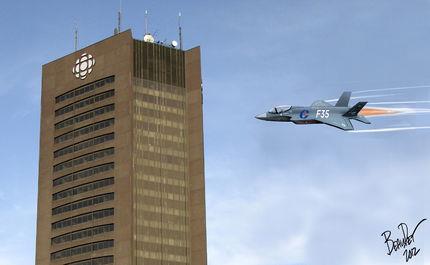
Rob Ford (to CBC’s As It Happens): Pardon me? I can’t talk to you right now—I’m really, I’m on a really tight schedule, so I hate to be rude, but I gotta let you go, and we can chat another time. Really nice talking to you, all the best, buh-bye.

(9) Which is worse — an organised Fascism hellbent on overtaking the world while methodically exterminating its opposition, or a disorganised Dumb hellbent on destroying the world in its mass stupidity? There is no equivalence here; there is no worse than worse; there is only the Worst for our times, and as such, it ought to be taken with pitchforks in hand, and fought without quarter.

Rise Freak Power.

Contesting Civil War: Tiqqun & Agamben

Wednesday, June 30th, 2010

Semiotext(e) have recently published the text Introduction to Civil War by the pseudonymous authorial collective Tiqqun. The text is number 4 of the Intervention series which has set for its mission the publication of recent works in political philosophy and political economy, including Christian Marazzi’s The Violence of Financial Capitalism (a crucial analysis of the recession) and The Invisible Committee’s manifesto of contemporary insurgency, The Coming Insurrection [download here].

These texts should not be taken lightly – or rather, these texts weigh heavily on the paranoia of the French state. In France, the alleged author(s) of The Coming Insurrection were violently arrested under “preemptive” measures that identified them as “pre-terrorists”. What is striking – and frightening – is that the Tarnac 9 by all accounts were not a revolutionary cell, but a small alternative commune living off the grid. Apparently such existence, outside of a few norms, is enough to invite the living nightmare of State hostility. Whether Julien Coupat wrote The Coming Insurrection is irrelevant. The text resonates with the zeitgeist that exploded in the banlieu riots of 2005. It is rightly anonymous as its claims are that of a world. Tiqqun’s Introduction to Civil War suggests the experience of the Tarnac 9:

Spectacle’s genius is to have acquired a monopoly over qualifications, over the act of naming. With this in hand, it can then smuggle in its metaphysics and pass of the products of its fraudulent interpretations as facts. Some act of social war gets called a “terrorist act,” while a major intervention by NATO, initiated through the most arbitrary process, is deemed a “peacekeeping operation.” Mass poisonings are described as epidemics, while the “High Security Wing” is the technical term used in our democracies’ prisons for the legal practice of torture. Tiqqun is, to the contrary, the action that restores to each fact its how, of holding this how to be the only real there is. (Civil War §82: 189).

(more…)

exodus & afrofuturism

Thursday, June 17th, 2010

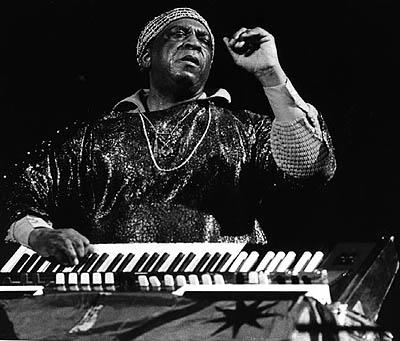
interstellar tones transport Sun Ra offworld

But in reality, it is the inherent failure of representation, both in the visual and the political sense, that continually leads activist-artists to abandon their works and their familiar skills, and to dissolve once again into the intersubjective processes of society’s self-transformation.

This moment of dissolution is where one could locate exodus, not as a concept, but as a power or a myth of resistance. On the one hand, exodus is a pragmatic response to the society of control, in which any widespread political opposition becomes an object of exacting analysis for those who can afford to invest major resources in the identification, segmentation and manipulation of what we naively call the public. In the face of these strategies, exodus is a power of willful metamorphosis: the capacity for a movement to appear, to intervene and to disappear again, before changing names and recommencing the same struggle in a different way. (Brian Holmes, Unleashing the Collective Phantoms: Essays in Reverse Imagineering @ 185)

Exodus is a movement — defection from the State, exit from the state of things, toward the formation of a “new republic” (as Paolo Virno puts it). While Virno and other Italian-based theorists of the Autonomia/Operaismo movement have traced exodus as a response to the factory regime of Fordist labour that saw its dismantling in the ’70s and ’80s, Brian Holmes has placed exodus within the artistic lineage of interventions and occupations, in which the fluidity of art, and of art as an occupation or role offers an exit strategy from institutionalized engagement. Holmes’ historical references are those of the alterglobalization movement, notably the public sonic occupations of Reclaim the Streets and the deployment of carnivale tactics in general, but also in specific art projects such as Nikeground. Here, art (and the artist) move through an interzone of activism and art, a zone in which intervention and representation are no longer distinct sides or sites of the work.

(more…)

the Myth of the Underground

Monday, May 24th, 2010

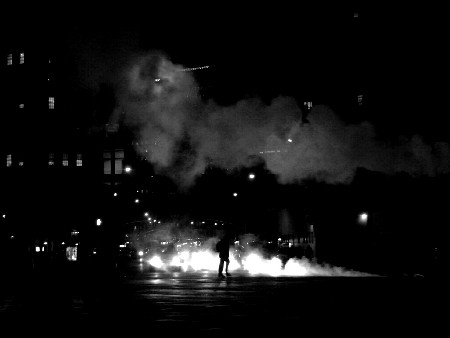
in the darkness the shapes of the light (thx to JBurke for this photo)

Excerpt from an unpublished missive — the mythus of the underground.

The outsider, insubordinate, and risk-laden character of dance, legitimated in this sense through its criminalization, provides participants with an outlaw or rebel identity forged in an ambiguous relationship with the law. — Graham St John, Technomad@20

The underground resonates with flights from the drudgery of everyday life into realms of secrecy and substance, where liberated encampments of rebel fugitives revel in the immediatism of autonomous existence…

(more…)

Canadian Colonialism — Conservative Style.

Saturday, May 8th, 2010

Canada's theocolonialist base gains new supporters from the South.

As Harper’s Conservatives spearhead a G8 initiative on maternal health in impoverished countries, the government refuses to include funding for abortion (despite the obvious need for it — see this 2006 report). Perspectives of power:

a/ Withholding abortion as a colonial weapon: Canada sets the 21C precedent in dictating the biotechnics of population control — and gender equality. In impoverished and poorly educated countries, patriarchal relations often restrict the use of contraception. No abortion, no choice, no knowledge, no change. Canada supports theopatriarchal systems of control, ignorance and governance.

b/ What happens abroad is a fantasy for the homeland. Denying abortion to others is a display of power among the powerless, and nothing satisfies the theocolonialist base more than enjoying the spectacle of their leader wielding the primitive tool of phallogocentric power over the weak. (Withholding abortion is phallogocentrism at is height: the yield of the phallus must prevail at its most transcendental moment, when sperm are signified by the sacred.) Of course, political power games trump true beneficence — we could say the Hippocratic Oath with strings attached yields hypocritical health. This charitable gift from Canada is theocolonialism by any other name; it bears historical precedence from handing out blankets infected with smallpox to First Nations.

(more…)

social media & its discontents

Wednesday, February 24th, 2010

Compared to Turin, and even Beijing, the Vancouver 2010 Olympicon is perhaps the first major sporting spectacle to bear witness to the rise in social media. Compared to the ’90s advent of Indymedia, social media is a very different beast. Indymedia came about as the convergence of traditional alternative media (such as college & campus radio, ‘zines, underground newspapers and pamphlets) with emerging internet technologies of self-publishing. When Indymedia saw its first introduction at APEC in 1997, going on to become a full-fledged, independently developed technical web platform for contributors with a centralized media hub at the Seattle ’99 WTO convergence, it provided effective coverage not only because it aired the footage of, and granted time to, perspectives that mainstream network-based television was either unable or unwilling to provide, but because it did so from a concentration of independent, alternative journalists who, though they may have differed as to the precise orientation of their political convictions, all agreed upon the common need for an alternative media network to represent the unheard side of the story.

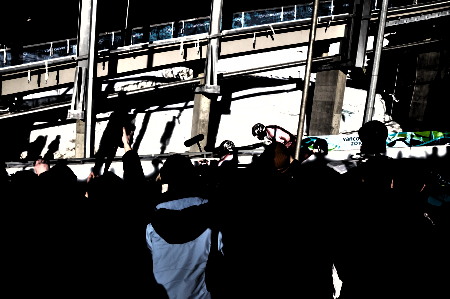
cameras out as the spectacle slides by. photo: tobias c. van Veen

(more…)

après moi, le deluge — & the Olympicon

Monday, February 15th, 2010

eye-in-the-sky security blimp over the Callaghan as the crowds press on toward a logistics nightmare

I am currently living in the midst of the Olympic maelstrom. For some reason I thought I might find myself frantically blogging the madness, but for the most part I find myself uninterested in doing so. Organised indie media such as the Vancouver Media Coop have kept it under control, and the damage is flying so fast & furious — see Democracy Now’s coverage of Olympic resistance to CBC on VANOC’s bad logistics & lack of venue foresight — that keeping up on Twitter seems to be the way to roll. So instead of daily blogging, I’ve been tweeting impressions & links [ @fugitivephilo ]. Anyway, first came the torch, and for that I have a video, ambivalence & beer included:

(more…)

mauvais foi (Psychodrama Demons)

Sunday, January 24th, 2010

Yet another bloodsucker dressing-up to play the Glamour game.

I think the motto of recent living for me could be DOWN WITH THE TROLLS & GREY VAMPIRES, BUT ABOVE ALL, DOWN WITH THE PSYCHODRAMA DEMONS. What’s these here Grey Vampires and Trolls? K-punk outlines the concepts:

Grey Vampires are creatures who disguise their moth-greyness in iridescent brightness, all the colours of attractive sociability. Like moths, they are drawn by the light of energetic commitment, but unable to themselves commit. Unlike the Toll, the Grey Vampire’s mode is not aggressive, at least not actively so; the Grey Vampire is a moth-like only on the inside. On the outside, they are bright, humorous, positive – everyone likes them. But they are possessed by a a deep, implacable sadness. They feed on the energy of those who are devoted, but they cannot devote themselves to anything. (K-Punk)

Psychodrama Demons are somewhere in-between a Grey Vampire and a Troll. A Grey Vampire appears somewhat romantic at times, caught in a melancholia, only able to live vicariously through others, even as their mode-of-being sucks away at the marrow of life, draining those around them. A Troll is more outright aggressive. As K-Punk writes, a Troll “above all wants to waste time, its libido involves a banal sadism, the dull malice of snatching people’s toys away from them” (K-Punk).

(more…)

anthronomics of the precariat

Monday, December 14th, 2009
"Precarious" issue of MUTE (Vol.2 #0)

"Precarious" issue of MUTE (Vol.2 #0)

What are the characteristics of the precariat? When one outlines the precarious class it is often by way of emphasizing the importance of cognitive labour. But sometimes discussions of cognitive labour (or what is known, somewhat incorrectly, as “immaterial labour”) glance over what Brian Holmes calls “the flexible personality.” As Holmes writes of his essay (originally published in 2001), the world has now commenced the

full implementation of the flexible employment system, that is, of a labor regime in which worker mobility and variable hours are accompanied by continuous electronic surveillance and the managerial analysis of performance. (Holmes, Flexible Personality)

(more…)