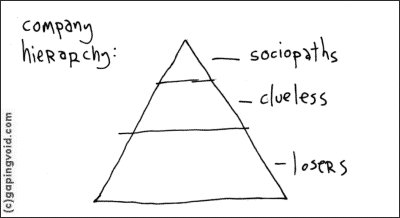
the pyramid of corporate cognitive labour
I recently came across a rather awesome analysis on Ribbonfarm that adds some much-needed complexity to the basic dichotomy between vertical and horizontal models of corporate control. These fantastic and well-writ posts (The Gervais Principle I and II) have been hit up on Slashdot and have circulated far & wide for good reason. Like Christian Marazzi’s work that deftly summarizes the significance of language to capital – the way language informs the fluctuations of the stock market and global economy (see Capital and Language) – Venkat analyses the way in which language is ab/used by particular players in corporate organisations. He deploys his deft analysis to unravel bureaucratic power principles as well as propose a theory of microclass. And he accomplishes this all by taking as his primary example the hit TV series The Office — Ricky Gervais’ brilliant satire of water cooler politics and management mediocrity. Venkat’s analysis, informed by his research into theories of corporate management, complements Marazzi’s observation that
In the post-Fordist context, in which language has become in every respect an instrument of the production of commodities and, therefore, the material condition of our very lives, the loss of the ability to speak, of the “language capacity,” means the loss of belonging in the world as such, the loss of what “communifies” the many who constitute the community. (Marazzi, Capital and Language: 131).
In his first post, Venkat complexifies the horizontal/vertical models with a theory of microclass. The Sociopaths (senior mgmt), Clueless (middle mgmt) & Losers (bottomfeeders) are constituted by their ability (or lack thereof) to learn, engage with, and ultimately ab/use corporate language for their own ends. In short, Venkat’s analysis jives with Marazzi, Virno and Berardi’s claims concerning not only the significance of language to contemporary labour conditions – insofar as linguistic affect structures fluctations of the stock market – but its operational effacity, insofar as linguistic competence structures the very field of labour. In short, one’s subjectivity under cognitive labour is structured by one’s ability to process the linguistic matrix of capital (which of course says much about education and class composition, among other things, but also about the linguistic seduction of capital – the great mass of all those who, to rephrase Spinoza, fight to remain slaves).
In Autonomist theory, this centrality of linguistic operations, interlaced and communicated by way of mobile and networked technologies, has been called the general intellect, insofar as the intellectualization of labour via technics constitutes the overall condition of cognitive labour. In this increasing technicization of labour, linguistic competence becomes the measure of labour itself: it is the brain that becomes the machine or engine of (cognitive) labour. As I think I’ll comment on in an upcoming post, mind you, I think the significance of a functioning brain is overrated in cognitive labour and it is a living-dead brain or zombie labour that still constitutes the scenario for the majority of the workforce (one is required to think, but not think too much). I think Venkat captures something of the zombie labour hyperthesis in his breakdown of the Loser class into two subclasses (becoming-Sociopath and Clueless Losers) and by analysing the seemingly lost Clueless as the middle manageriat, i.e., as those who believe the most in the conditions of their own enslavement.
In his second post, Venkat breaks down language into Posturetalk, Powertalk, Babytalk & Gametalk, and details how it is ab/used by each class. Powertalk is the language of control and conquer used by Sociopaths; it works on multiple levels at once, communicating several meanings in discrete semantic utterances. Such communication is a poker game of words, where what is left unsaid determines the value of what is said, where parameters of the language game itself are relayed in the delivery of each utterance, and where ambiguity destabilizes erstwhile assurances. While the Clueless attempt to imitate Powertalk, they only fail to grasp the most superficial level of its meaning, and though they might deploy all the buzzwords, the Clueless can only speak Posturetalk – all copy and no depth, all bark and no bite. For Powertalk is only Powertalk if the speaker has table stakes — some actual informational capital to wager. In a similar way, Gametalk is what Losers like to talk to each other, which is basically showroom-style hot air; but as this is a language for Losers only, it holds no value, unlike the way in which Posturetalk signals that one is dealing with a Clueless class member. And in a truly brilliant move, Venkat outlines how Babytalk is not only what Sociopaths use to communicate with the Clueless – for the Clueless can’t grasp Powertalk – but Babytalk is also the language that Losers use to address their middle management superiors, which is why Losers are the breeding ground of Sociopaths as well as containing an exodus-class of what I will call “Carefrees” who know perfectly well the game but have no real interest in playing it. And in those rare instances where upper management Sociopaths talk directly to Loser minions, a variant form of Powertalk is used called Straight Talk — a direct and one-way command utterance with threatening overtones. Mind you it is also in such instances that a becoming-Sociopath Loser can demonstrate their knowledge of Powertalk and forge a path to senior management.
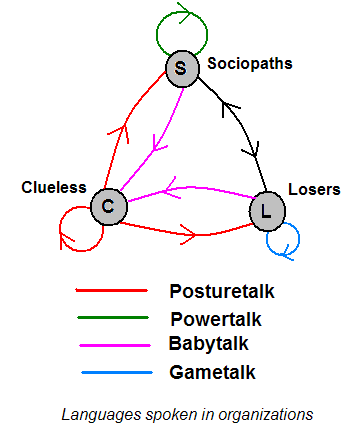
Venkat's Gervais Principle Language Model
Like all great fiction, The Office models only what is more real than reality, the world in its representation, in its vicious deployments of language and power. One moment I particular dig in this worthy read (which I cannot do justice to here – do go and devour it) is when Venkat contrasts The Gervais Principle with the Dilbert Principle:
Scott Adams, seeing a different flaw in the Peter Principle, proposed the Dilbert Principle: that companies tend to systematically promote their least-competent employees to middle management to limit the damage they can do. This again is untrue. The Gervais principle predicts the exact opposite: that the most competent ones will be promoted to middle management. Michael Scott was a star salesman before he become a clueless middle manager. The least competent employees (but not all of them — only certain enlightened incompetents) will be promoted not to middle management, but fast-tracked through to senior management. To the sociopath level. (Venkat, Gervais Principle)
Venkat adds a subtle flavour here, though he isn’t quite acknowledging that both principles appear to be operational and correct. The Dilbert Principle applies in general: middle management is composed of the Clueless. That said, the truly incompetent remain as Losers – those forever loyal to the company but who will never achieve middle management as quite simply they do their menial jobs too well (though it’s hard to say who is more incompetent: the Losers who never get anywhere or the Clueless who believe they have gotten somewhere by becoming middle management but are just being played by the Sociopaths as a buffer between the upper management and the lumpenLosers). Indeed, it is the deployment of the Clueless as the buffer between the harsh and vicious world of the Sociopaths and the lumpenLosers that marks Venkat’s insight – for it also opens the door to possible action. Remove middle management, and a classic class antagonism reveals itself in all its possible violence. As Venkat puts it, the Clueless mediate between an otherwise untenable master/slave dialectic.
What I also dig about Venkat is that the Losers aren’t just “losers” in the usual, derogatory sense but are often composed of the completely Careless who couldn’t give a rat’s ass about this powergame – those coasting by who watch it unfold all around them and say to hell with it. The Careless Losers – the carefree, perhaps – have something else going on in their lives and see work for what it is: a distraction from what counts. In this sense, the Losers, as the biggest group that constitutes most of us, are composed of that “silent majority” that upholds a good deal of old fashioned anarchist sensibility: act as if the State/Corp doesn’t exist. In the indication of a blindspot within an organisation’s powergame environment, Venkat’s analysis suggests that other systems of power might lie elsewhere. This elsewhere keeps those with an ear to the outside constantly seeking an alternative means to living without working, and as Virno suggests, means that exodus (or the politics of disappearance) constitutes the general strategy of the (Loser) workforce.
The other strategy is, of course, to try and manipulate the system from the inside. And those with some sense of how to manipulate language (the Sociopaths) forge a path directly from Loserdom to senior management. Becoming-Sociopath Losers aren’t headhunted because they do their menial job well, but because they demonstrate (by subtle language signs) that they know that their job is worthless by the standards of other Sociopaths. By slacking in their work (getting others to do it for them or just plain deferring it) and putting the extra energy into getting ahead (manoeuvring and conniving), and taking advantage of risk-taking scenarios (playing the game), Sociopaths advance directly from Loser status to senior management — which does not necessarily imply that a Sociopath is bad. For if one is playing the powergame for different ends, such strategies are also the purview of the good. For this general assessment of power applies as much to NPOs and artist-run centres as it does to oil corporations and PR firms.
Check out how the way language plays into this sacking story recently sent to me (the author requested anonymity):
The most telling thing, in my 15-year design career, is I’ve never worked anywhere longer than two years. I’ve been made redundant once and been sacked one and a half times.
The first sacking came on a Friday evening completely out of the blue. It was at the end of the month, so it was nice and tidy for them. The boss had been out of the office all afternoon, walked in the office and asked to have a word with me outside the door. He simply said: “we’re going to let you go”— that was it. I walked away there and then. He did my colleague, the same way, 3 minutes later. Needless to say, it was ruthless and illegal. There was no dismissal process followed.
However, at the time, the job market was buoyant and I got a way better job (oxymoron) shortly afterwards. Needless to say, that company has been erased from my CV. It’s a futile act but it feels the most dignified response to how I was treated— walk away, shake the dust from your shoes and take back control.
The ‘point 5’ sacking was more gentle and evolved over the course of a month. It came to a head and can be summarised in one sentence. They said: “I think you need to move on”. I agreed and left at the end of the week.
*.*.*
Tags: anthronomics, cognitive labour, disappearance, exodus, general intellect, Marazzi, precarity
.tinyUrl for this post: | https://tinyurl.com/ycvalt8s .


 RT
RT 
tobias I “need to have a word with you”
When I read this I almost had a minor heart palpitation until I saw who was writing. Ah, the kiss of death, eh? I just want the Fight Club scenario — self-destruction is the path to liberation. Beat yourself up & blackmail the company. Now that’s classy.
managing language (with extreme prejudice) « fugitive philosophy | http://bit.ly/5FndAW
managing language (with extreme prejudice) « fugitive philosophy | http://bit.ly/5FndAW
Appreciate the thoughtful response.
While I do speak PoMo well enough to understand most of what you wrote, I have to admit, I am overall very wary of this particular analytical lens, even (and perhaps especially) if the conclusions appeal to me. This is primarily, I think, for two reasons. First, I am pretty much a complete Darwinist, while most humanities-origin discourses begin with what Pinker and others have characterized as the blank-slate assumption (I just finished ‘The Red Queen’ which has some relevance to this conversation, as well as broader points to make about blank-slate-based analysis). Second, I find that most discourses also have a consistently Other-oriented politics. All discourses are political discourses of course, but I don’t trust a domain where they are all too similar 🙂
That said, once I recheck/reanalyze the conclusions of PoMoers through a Darwinist lens (which generally confirms them, and yields simpler language), I do find value.
Someday I might even read Foucault.
Thanks for adding to the lively debate. I’ll link to this post the next time I do some sort of roundup on the GP series. I don’t agree with all your conclusions/representations, but we are roughly, directionally, aligned.
Venkat
Thanks indeed for the reply, Venkat. True, I am deploying a number of terms here drawn from contemporary political economy, as this has been a significant thrust of my research of late. However I would hesitate to group these terms (or their concepts) under any kind of ‘post-modernist’ baggage. The contemporary political theory I am looking at, though drawn from thinkers/activists who cut their teeth in Italy in the 1970s (what is known as Autonomia/Operaismo), is very much a product of recent analyses of worldwide socio-economic conditions. In regards to PoMo — which I would need to hear your definition of, as I have no idea what it means in this context — it seems to me that PoMo as conceptual construct died sometime in the mid’90s after having its heydays in the ’80s. What we are dealing with here is materialist political economy of a sort that incorporates brain labour and the role of technology into its analysis as well as the production of subjectivity — the latter which is laid out especially well in your own piece. Btw, by proposing that what you have writ constructs a theory of ‘microclass’ I am quite explicitly deviating from the usual PoMo party line (if there is one) which often argues against the construct of class.
In any case, the political economy I am working with has somewhat side-stepped much of what is characterized as PoMo in terms of relativism, subjectivity, and otherness as ethical object. As for the language, indeed it is only because I am, again, seeking to translate your concepts into a particular discourse with the usual conceptual abbreviations that it perhaps comes across as PoMo. It’s simply the aim of this particular bit of research.
That said, I should probably note that I find all kinds of discourses difficult to read, and often have to retranslate into a language I find makes sense to me. Once I do, like you, I often find much to absorb, think on, and analyse, whether it be by contestation or acceptance. And to this I think we can shake hands. If we take the Gervais Principle seriously enough, then we have to realise that we are both working within certain language-games. It all gets very Wittgenstein. 😉
In terms of Other-orientation in this Autonomist discourse, the notion of the Other does not arise in the sense I think you suspect. Indeed, the sense of alterity is thought through the multitude, which is seen as the assemblage of all human differences bound by language and technology. While someone like Toni Negri puts a Marxian spin onto it (the multitude is the new global proletariat), a thinker like Paola Virno, whom I value greatly, thinks multitude as form without content, meaning that while the network exists, it does not necessarily mean that its human content is good, or determined toward a particular outcome (ie some quasi-socialist good state etc via revolution and all that). I am more or less interested in Virno (though Negri’s analyses are brilliant), as I think while particular forms of human association have arisen through what Autonomia calls cognitive labour, they do not gesture definitively in any particular direction for human society as a whole. Which is why I particularly enjoy your analysis of the Office, because the Losers, for example, can contain both Clueless and Sociopaths; another way of talking about Losers, perhaps, is talking about the multitude — the great lumpenclass at the bottom that holds both potential and disaster in one fell swoop. And the ambiguity you discuss between good/bad Sociopaths is, in this sense, oh so very postmodern. 😉
Foucault is a worthwhile read btw — his work on disciplinary structures is well known, but the Panopticon as model of society is the easiest fruit to pick from the tree. His lectures on biopower, security, territory, population and governmentality from the 1970s at the College de France might be of interest to you. He is fundamentally a historian who pursued questions of a rigorously epistemological nature concerning the production of historical knowledge itself.
As for Darwin, I am not sure what makes one a Darwinian, though the tracing of evolution seems the basic platform of scientific understanding today. I would rather not be branded anyone’s follower nor follow anyone’s proper name. How Darwin’s research accords with what the old philosophers called free will — the general problem of translating Darwin’s work into what has been called ‘social Darwinism’ — or what the relation might be between oneself and one’s genes, might better be thought, well, in terms of something from Freud that takes into account whatever one wants to name the Unconscious. In this respect, and to be very brief, all the work of Derrida/Lacan/Zizek, among many others (Kristeva, Klein, Guattari), offers much potential in thinking how Darwin might relate to the human condition. In much of this work, the ‘Other’ is thought as an incorporated alterity, an other-subjectivity residing within, which means that one’s actions are never wholly one’s own, but always in a process of complex communication with the loops of language and technics that construct (active) perception/interpretation in the construction of (a) world.
This might sound a bit heavy, as it comes from a reading of Husserl’s phenomenology — the study of consciousness and the perception of objects in consciousness — but I think it makes sense to say that, following Darwin, I as a human am not wholly in control of what I am or where I am going; there is something else involved that is not only ‘out there’ but ‘in me’ and this bit in me that I know not what makes me ‘me’. But to say that this is a gene and that this gene knows something I do not is not quite right, and simply instills the gene with the old power of the religious deity and anthropomorphizes it. Indeed, the relation between genes (or what psychoanalysis calls Drives) and the Unconscious is one that Zizek often exploits to great effect by analysing film, and I would highly recommend checking out (if you haven’t) his –Pervert’s Guide to Cinema-. I would tend to think that Darwin would laugh along — and would give much thought to what has followed in his wake.
Thanks for writing. And thanks again for your incisive & witty work.
All the best/ tobias.
Interesting academic take on the gervais principle by @fugitivephilo for those who speak some pomo http://bit.ly/6SeuuQ
Re: PoMo and its descendants, I honestly think only those within that corner of academe actually care about the finer distinctions. I once had a woman describe herself to me as a ‘post-post structuralist’ and it left me feeling like I was listening to an identity crisis confessional 🙂 I think at least when talking to those outside their world, the best strategy is to accept with good humor that PoMo has become the catch-all term for any post-Derrida non canonical reading of culture and the human condition.
I am not very well informed on these matters, but I’ll take your word for it that class isn’t a construct PoMoers like (though for whatever reason the more superficial PoMoers I’ve met seem to be very Marxist too…and unreconstructed-Freudian to boot)
Darwinism… if you don’t like the proper name, let’s just say “evolutionism.” I think when evolutionists make the ‘blank slate’ critique (first leveled at Skinner, but then extended to most of the humanities beyond psychology), they mean that humanities analysts tend to look for complicated accounts of human stuff when near-trivial evolutionary-biological explanations exist, but offend the moral politics of PoMoers (for example, gender differences is a big and obvious and undeniable conclusion from evolutionary thought, but many of the more Marxist-oriented PoMoers insist on “genders are mentally the same” as a starting point of analysis). It is still a force in academia; witness Larry Summers getting fired as president of Harvard thanks to humanities lashback against biologically well-motivated conjectures about gender differences.
Posted a follow up on ribbonfarm, incl. a short discussion of your ‘exodus’ stuff.
I read a summary of Husserl’s stuff back when I was really interested in consciousness and philosophy of mind. Never got deep into it though.
Thanks for interesting conversation. Been too long since I left grad school, and I do miss it on occasion 🙂
Thanks indeed for the conversation, Venkat. Your insights are, as usual, mind-opening. I checked out your post, thanks for cutting out all the crap. 😉
All those finer distinctions wrought in careful argument, of course, are as important to philosophers and cultural theorists as, say, the distinction between the way certain kinds of cells operate to a neurobiologist. You wouldn’t want to confuse seratonin for dopamine, though both are interrelated and the complex nature of their functioning is still under investigation. The devil is in the details.
Or to put it another way — we wouldn’t want to confuse Posturetalk for Powertalk. If one did, one is probably Clueless.
Heck, if you can stomach Husserl you can stomach the evolution of philosophy’s language games. My apologies for overdoing the parenthesis parade. The blog is often writ in shorthand. I’ll try to sidestep the pomo whenever possible. But at least when talking about Autonomia, to engage in the discussion, one needs to use the language terms in which the game is already being played. This becomes especially true when one is writing between different languages, where terms have accepted English translations from Italian and French.
best indeed / tobias.
Precise language has its place of course. I use it myself still, on the rare occasion that I write for academic audiences these days.
Sometimes I miss that, and someday I might go back and do more of that, but for now, it is the shoot-from-the-hip stuff of blogging that I enjoy the most 🙂
Indeed, your language be quite precise in its blazing style. But enough about language. Your take on my take on exodus has me thinking, so I might sketch together a few ideas on exodus and mass adoption in the next few days. cheers indeed/ tobias.
[…] A weird, but intelligent, response that someone wrote. The comments are well worth reading. I loved the opener “While I do speak PoMo well enough to understand most of what you wrote…” […]
[…] volunteer organisations, and of course, most corporate environments. After some consideration of management languages and hierarchies, it would appear that there be a third subject position between hideous Trolls and Grey Vampires […]
everyone wants to be clueless http://t.co/s1FXp0bV