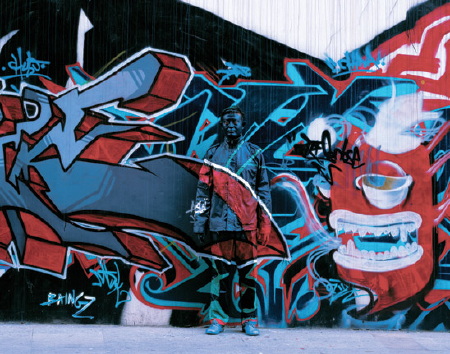
Disappearance as a strategy: to flee confinement by way of a slippage between sign and symbol. As enacted in space, through time. Rave culture enacts a level of disappearance, by slipping away from the usual concept of a counterculture’s visual opposition. The visual is switched for the sonic. The punk on the streetcorner for the raver in the warehouse. Rave culture switches day for night. It doesn’t disappear from the day as it was never there.
In the 21C, disappearance would mean to conduct something of a digital erasure of the archives. To disappear would mean to delete all traces of oneself. But such an absence only gestures toward its horizon: a hole where once there was the whole. Strategically, for disappearance to be effective — which is to say, unnoticeable — something of a blending operation must take place. A slippage between sign and symbol.

Chinese artist Liu Bolin paints himself into the background. By statically inserting his body, he becomes integrated into his surroundings. He blends-in (and of course, plays all the stereotypes of Chinese conformity by doing so). Bolin’s strategy is not so much disappearance as it is the ineffective demonstration of camouflage coupled with the effective demonstration of symbolic disappearance. Camouflage has never been so ineffective as in the case of Bolin, where its illusion requires the precise placement of one’s body (without movement, viewed from one perspective only). Yet the failure of camouflage (even when its representation catches us by surprise as we search for his increasingly elusive body) foregrounds a greater strategy: the slippage between sign and symbol. The body as outline of the person is now clearly outlined as little more than it is, a surface of itself, a patina without depth, capable of reflecting its background, capable again of faking its own transparency. The body is not to be trusted; nor is the perspective of the viewer.
- Unregistered shots across the bow (Liu Bolin)


- De/Construction (by way of Liu Bolin)

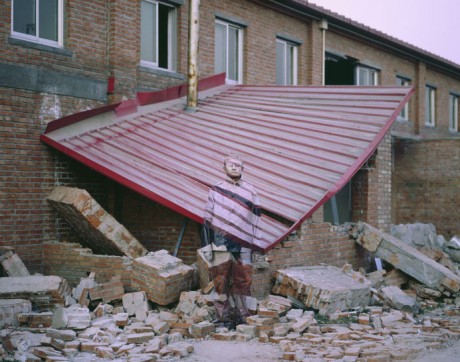
- Portrait of the Artist as Unseen (Liu Bolin)
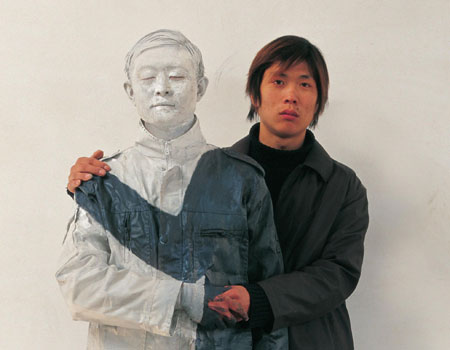
Disappearance as strategy, by way of slipping between sign and symbol, requires the unsettling of perspective while retaining its expected characteristics. If a generalized perspective, such as the map, cannot be trusted to represent the territory, than those items already on the map, many among the millions, might be discounted, along with so many others, as extraneous information. Data unlikely from which to proceed. “Hiding in plain sight” – Underground Resistance.
Choosing to truly hide within the perspective of the firing-range, to attempt to disappear by way of obfuscation, always results in disaster. Never choose obvious cover. Never hide (per se).
This post has been government funded (in part):

How Not To Be Seen (As Monty Python Sees It)
Edit — added:
One thing I did not mention (as it perhaps warrants another post) is that Bolin politically orients his work. According to Infoniac.com, his Beijing studio was shut down by the Government in 2005 which prompted his “Hiding in the City” series of photographs, all part of a shift from “dependence to revolting against the system” (Bolin’s words). Check it:
“I am standing, but there is a silent protest, the protest against the environment for the survival, the protest against the state. I wanted to photograph the reality of scenes of China’s development today.” – Liu Bolin
Tags: disappearance, Liu Bolin, rave culture
.tinyUrl for this post: | http://tinyurl.com/358cep5 .


Hi Tobias, I did not know about Liu Bolin’s work. Great stuff (and well framed) – thanks!
Thanks G, I was quite taken by it myself. One thing I did not mention (as it perhaps warrants another post) is that Bolin politically orients his work. According to Infoniac.com, his studio was shut down by the Government in 2005 which prompted his “Hiding in the City” series of photographs, all part of a shift from “dependence to revolting against the system” (Bolin’s words). Check it:
“I am standing, but there is a silent protest, the protest against the environment for the survival, the protest against the state. I wanted to photograph the reality of scenes of China’s development today.” – Liu Bolin
http://www.infoniac.com/offbeat-news/the-silent-protests-of-the-invisible-man.html
[...] an alternative means to living without working, and as Virno suggests, means that exodus (or the politics of disappearance) constitutes the general strategy of the (Loser) [...]
Thanks Venkat. Yes, well put. Exodus is a contentious strategy if seen as one. And the references certainly become Biblical. Indeed.
In one way, exodus is the general malaise of democracy. Most of us don’t vote and don’t care, for example. This kind of exodus from participation can be seen in two ways. In one way, it signals that conventional involvement in political life is falling apart. Democracy itself might be at stake. But in another way, it signals that people are making-do in other ways. That by exiting en masse from political life, they are creating networks and ways of coexisting in their own manner (and the Net has much to do with this).
As for work, you are absolutely right. One needs to work and exodus is something of a privilege if thought as ‘leaving one’s job’. But exodus can be more subtle, in the sense that the Checkout Losers have invested meaning in their lives somewhere other than work, and are willing to sacrifice work, and its monetary reward, in order to live otherwise.
I live in a ski bum town at the moment, one about to be overrun by the world — yes, Whistler, heart of the Olympicon. And here exodus is the modus operandi of the workforce. Bums since time immemorial have drifted off when the big machine comes in, or the boss demands too much. Quite simply, the possibility of picking up and going elsewhere is the main trend of economic activity here for Losers. The local economy itself recognises this; it’s called the “seasonal workforce.” But what is also interesting about exodus in this manner is that other values beside work mean more for many people in a place such as this. Outdoor activities, and life itself, has more value than having a lot of money.
There is a paradox of course; Whistler is increasingly prohibitive to live in. A recent study (see the Pique January newspaper) shows that 85% of Whistler residents don’t make enough money to cover their living costs. That number corresponds with the number of seasonal workers. Most people working here technically live below the poverty line (though in Western comfort), and earn less so they can, usually, ski more.
Of course at some point, it all caves in, and either you ‘grow up and get a real job’ or become the toothless hippy living in a shack in the woods (a lot of those dudes have been kicked out by the military with the Olympics comin’).
Or you find some kind of way to make it work — that dream exodus job, as a pro snowboarder, photographer, in the outdoor industry somehow, that kind of thing, where work and life mesh. Where your job is something you love.
In Italian Autonomist thought, such as that of Paolo Virno, exodus is the general response since the ’90s of the worldwide workforce to increased demands on their time for a decreasing average wage. Mass amounts of people check-out in many ways. Heck, what we’re really talking about what was picked up by Douglas Coupland in -Generation X- and Richard Linklater in -Slacker-. A kind of drifting-away from exhausting demands toward living life the way one wants it, now, in whatever meaningful one can find.
Of course to engage in exodus on this level means that one already inhabits a fairly privileged sphere of existence. Most of the world is still trapped in slave labour factories, without any of the complex relations of the Gervais Principle at stake; most of the world is hungry, and getting by any way they can.
But perhaps the West’s exodus opens the territory for the great flood of the world’s underdeveloped.
Thanks Venkat, your analyses are superb as always.
This comment was originally posted on ribbonfarm
I wanted to tell you that I thought it was great the one reaction I read to your post on Gervaise principle on the blog Fugitive Philosophy.
I think the metaphor post also diserves interesting reactions, I am actually considering writting one (hope you don’t mind).
Here is what I commented on mashable, I copy it here also to see what you think about it in person:
Excelent article, I loved it, congrats about it.
Here is another reason explaining why metaphors might not work (which might be applied to the document one):
“Metaphors are markers of the roots of thought itself. They are the main mechanisms through which we comprehend abstract concepts and perform abstract reasoning. Abstract thought would be meaningless without bodily experience. People think with their brains and their brains are part of their bodies as well”. – Lakoff and Johnson
More here: http://singyourownlullaby.blogspot.com/2009/10/…;
Twitter and the stream can also be considered metaphors, you can explain the stream one as:What the Web is thinking and doing, right now. It’s our collective stream of Consciousness. The Stream is the dynamic activity of the Web, unfolding over time. It is the conversations, the live streams of audio and video, the changes to Web sites that are happening, the ideas and trends — the memes — that are rippling across millions of Web pages, applications, and minds.
More here: http://singyourownlullaby.blogspot.com/2009/05/metaphors-everywhere.html
And also like Spivak described it:
“If the Internet is our collective nervous system, and the Web is our collective brain, then the Stream is our collective mind. The nervous system and the brain are like the underlying hardware and software, but the mind is what the system is actually thinking in real-time. These three layers are interconnected, yet are distinctly different aspects, of our emerging and increasingly awakened planetary intelligence. The Stream is what the Web is thinking and doing, right now. It’s our collective stream of consciousness”.
More here: http://singyourownlullaby.blogspot.com/2009/05/…;
Let me tell you also that I consider your conclusion excelent.
This comment was originally posted on ribbonfarm